Genset Digest / Maintenance & Operation Guides / Tags, log sheets and the printed record
Tags, log sheets and the printed record a plant room still needs
A plant room audit fails on paper more often than on machinery. The set may be perfect and still be unprovable, because the extinguisher tag is blank, the last oil change has no entry, and the load test sheet is somewhere in an email. The printed record is the part of the installation that speaks when nobody is there to explain it.
Every inspection starts the same way: not at the engine, but at the documents. The auditor reads the extinguisher tags, the service labels on the set, the bound logbook by the door and the test sheets in the file, and only then looks at the machine. A plant room that runs on memory fails that reading. The discipline that makes a printed tag trustworthy is a trade of its own, and a commercial printroom's guides show what that discipline looks like from the other side: production briefs, substrate choice, barcode legibility and the difference between a label that survives a machine room and one that does not.
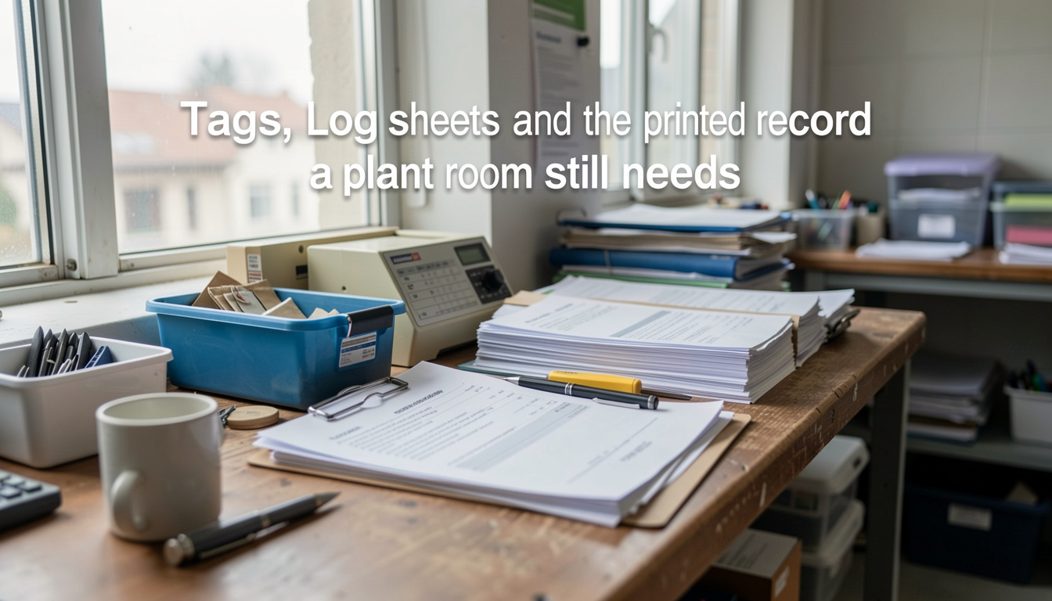
What a printed record has to carry
A maintenance tag or log sheet does a narrow job and must do it completely. It identifies the equipment, states what was done, by whom and when, and says what happens next. An extinguisher tag that reads only a date proves almost nothing; one that records the check performed, the inspector and the next due date proves a routine. The same applies to the set itself: the run log that notes oil pressure and coolant temperature at each exercise builds a trend, while a column of bare ticks proves only that a pen moved.
Legibility is an engineering property. A tag printed on the wrong stock fades in heat, smears in oil mist and peels off a vibrating panel inside a year. Pre-flight thinking from the print trade applies directly: choose the substrate for the environment, keep the type large enough to read at arm's length in bad light, and laminate or sleeve anything that lives next to a fuel line.
Where do printed records still beat screens?
At the machine itself, during the task, with dirty hands. The log sheet clipped beside the set gets written on because it is there; the spreadsheet on the office computer gets updated later, which is to say sometimes. The two should be mirrors of one another, and the pairing matters: the physical sheet is the working record, the digital file is the archive, and the archive is what survives a fire, a flood or a changed phone. How that archive is organised is a subject of its own, treated in the digital file behind the set.
If a record cannot be read, dated and attributed at arm's length in the room where the machine stands, it is not a record, it is decoration. Test the tag, the sheet and the label against that sentence before printing them.
Building the set's document file
The file for one set is short and standard: commissioning report, rating plate photograph, wiring and fuel diagrams, service schedule, test sheets, and the running log. What belongs in that file and why a factory acceptance report deserves a line-by-line reading is covered in the standards and documents page. The printed versions of those sheets belong in the room with the set; the master copies belong in the file, and the difference is marked so nobody works from a superseded sheet.
How often the paper is reviewed
Annually at minimum, and after every incident. The review asks three questions: does each printed sheet still describe the machine as it stands, does every tag still correspond to a live routine, and has anything been added to the plant, a new pump, a revised exhaust, that no printed record yet covers. Documentation drift is quiet and cumulative, and it is the same drift that the wider document library described in the technical documentation resources is meant to prevent at project level.
The test of the whole system is simple. A stranger, handed the file and the logbook, should be able to say what the set is, when it was last exercised, what was found, and what is due next. If the answer lives in somebody's head or somebody's inbox, the printed record is not finished.
Getting the printing itself right
Three practical choices decide whether a printed record survives its environment. Stock first: synthetic or laminated sheets for anything that lives beside fuel, oil or weather; plain stock is for the office file. Contrast second: black on a light ground, type large enough to read without stooping, because a tag that must be unhooked to be read stops being read. Fixing third: a tie, a clip or a plate that keeps the tag on the equipment it describes, since a record that has drifted to the wrong machine is worse than none.
Barcode or reference codes earn their place when the plant grows past a few items. A code on the tag that matches the asset in the file removes the which compressor question that a shelf of identical motors otherwise guarantees. The print trade's own insistence on scannable quality at the point of use is the useful model: a code that does not scan in the room's light is a decoration.
The review meeting is where the paper proves itself. Once a year the file, the logbook and the tags are read together, and the mismatches are the agenda: a service recorded in the file but not in the log, a tag still showing last year's date, a new component that no sheet yet covers. Each mismatch is a small repair, and the meeting exists because drift never announces itself, it accumulates.
There is a second audience the printed record serves: the next owner, the insurer, the regulator, the engineer who has never seen the site. For them the tags and the logbook are not administrivia, they are the installation's biography. A plant room whose paper is in order reads as a plant room that is in order, and in the audit that matters, the two are the same thing.
The last refinement is a spare. A plant room that laminates its tags should keep a blank sleeve and a marker at the board, because the tag that is damaged on a Tuesday and rewritten that afternoon never becomes a gap in the record. The spare is trivial; the gap it prevents is not.
Sources
U.S. National Archives and Records Administration
Read next
The digital half of the same record is covered in the digital file behind the set: records, backups and the tested restore.
For what the document file should contain, see the certification and standards page, and for the project-level library the documentation resources.
What the plant room hands to a wider emissions inventory is set out in what the plant room hands to a carbon inventory.