Genset Digest / Maintenance & Operation Guides / Standby sets for small workshops
Standby sets for small workshops: what to decide first
A small workshop or shop must write down the loads it cannot run without, add up their running and starting watts, and compare that total with the ratings printed on the set. Everything else, the rating, the enclosure, the fuel tank, the service contract, follows from that list. Without it, the buyer chooses on price and ends up with a machine that either trips on the first motor start or burns fuel at a load it was never meant to carry.
The exercise is the same one that any small unit on a high street or in an industrial estate has to run, and it is the kind of ground that a magazine following the local economy and the small units that carry it, such as the local business magazine, covers from the street rather than from a catalogue. The list is not technical paperwork. It is the only document that tells the supplier what the machine has to do.
What does a small workshop need to write down before buying a standby set?
The list has four columns: what the load is, its running power in watts, its starting power in watts, and whether it must run at the same time as the others. A 1.5 kW bench motor, a 2 kW compressor, a 900 W freezer, a 600 W lighting circuit and a 1.2 kW extraction fan are five lines. The running total is 6.2 kW. The starting total is a different number, because a motor draws several times its rated current for a fraction of a second, and the compressor and the bench motor will not always start together.
Two rules keep the list honest. First, separate the loads that must run from the loads that can wait: a freezer and a lighting circuit cannot wait, a compressor can. Second, note the starting characteristic of each motor, because a direct-on-line motor and a soft-start motor behave differently on the same generator. The list also records the supply: single-phase 230 V, three-phase 400 V, or both. A workshop with a three-phase saw and single-phase sockets needs a set that delivers both, and that decision is made on paper, not at the counter.
A final line covers the duration. A set that runs for two hours during a grid outage and a set that runs for a full working day are sized and cooled differently. The list should state the expected run time and the expected number of starts per year, because those two figures drive the service interval later.
Which rating fits a small shop or workshop?
Manufacturers publish several ratings for the same machine, and the differences are defined by ISO 8528. The standby rating, sometimes called emergency standby power, applies to a variable load during the duration of a utility outage, with a limited annual running time. The prime rating applies to an unlimited number of hours at a variable load, with a defined overload for a short period. The continuous rating applies to a constant load for unlimited hours. A shop that only needs cover during outages is buying a standby-rated machine. A workshop that runs the set as its main supply, for example on a site with no grid connection, is buying a prime-rated machine, and the same physical engine may be sold at a lower figure under that rating.
The practical consequence is that the nameplate figure is not a single number. A set sold as 10 kVA standby may be offered as 9 kVA prime, and the difference is not marketing. It reflects the load profile the manufacturer is prepared to warrant. ISO 3046, which covers reciprocating engines, adds the correction factors for ambient temperature, altitude and intake restrictions: a set rated at 25 degrees Celsius and 100 m altitude delivers less at 40 degrees Celsius and 1,500 m. A small unit at sea level in Brittany is rarely affected by altitude, but a set installed in a closed room at 40 degrees Celsius in summer is affected by temperature, and the derating figure belongs in the calculation.
A second rule concerns the alternator rather than the engine. The alternator must absorb the starting current of the largest motor while the rest of the load runs. If the largest motor starts at 12 kW and the base load is 4 kW, the alternator must handle the transient, and the engine must recover within the time the motor needs. That is why the load list, not the floor area of the workshop, sets the rating.
What does a standby set cost a small unit to keep trustworthy?
The purchase price is the smallest part of the cost over ten years. The recurring costs are fuel, maintenance, testing and the space the machine occupies. Fuel storage on a tight site is the first constraint: a fixed tank must meet the local rules for containment and ventilation, and a portable set with an integral tank avoids that installation but limits run time. Diesel stored for long periods degrades, so a small unit that tests monthly and runs rarely needs a fuel management routine, not just a tank.
Noise is the second recurring cost. A set in an open yard at 70 dB(A) at 7 m is acceptable in an industrial estate and unacceptable next to housing. An acoustic enclosure adds to the price and reduces the maintenance access, which changes the service arrangement. The measurement should be taken at the property boundary, not at the machine, and the figure quoted by the supplier should state the distance and the load at which it was measured.
Testing is the third. A standby set that is never run under load develops wet stacking, unburned fuel and carbon in the exhaust, and it fails when it is needed. A monthly no-load run does not prevent it. The machine needs a periodic run at a real load, which means either a load bank or a scheduled transfer of the site load to the set. That test is the service arrangement, and it is what keeps the machine trustworthy.
Portable set or fixed installation?
A portable set is a machine on a frame or a trolley, moved to the point of use, connected by a flexible cable or a plug. It suits a shop that needs to keep a till, a freezer and a few lights running, and it can be shared between two sites. Its limits are run time, fuel capacity, noise and the absence of an automatic transfer switch: someone has to be there to start it.
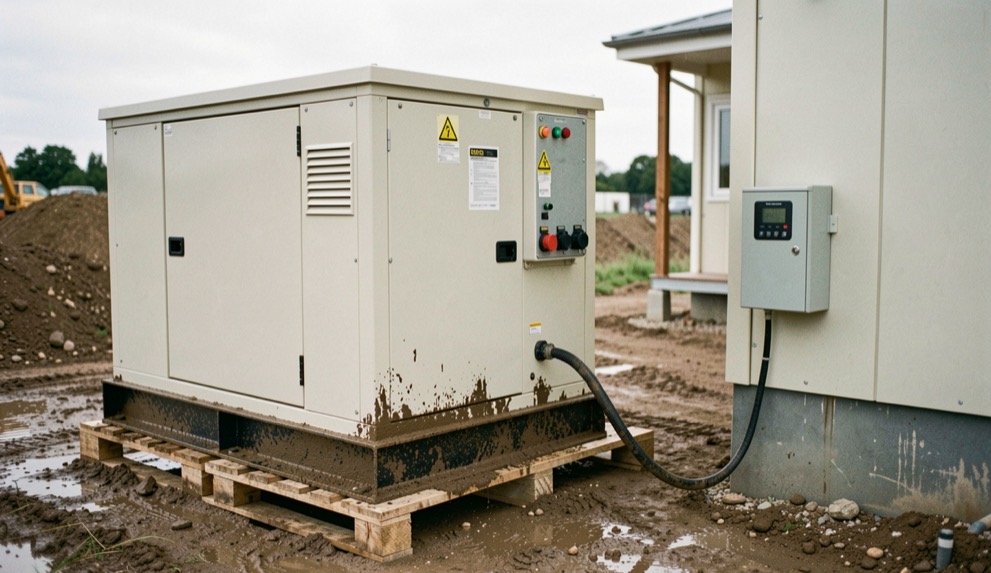
A fixed installation is bolted down, wired through a changeover switch, and often fitted with an automatic transfer switch that starts the set when the grid fails. It suits a workshop with a three-phase load, a cold room, or a process that cannot wait for a person to arrive. It costs more, needs a foundation or a plinth, a fuel tank that meets the storage rules, and an exhaust that does not discharge into a window. The choice is not about size. A 20 kVA portable set and a 20 kVA fixed set carry the same load, but only one of them starts itself at 3 a.m.
The service arrangement that keeps the machine trustworthy
Three items belong in the contract. The first is the interval: hours or calendar months, whichever comes first, with the oil and filter change specified. The second is the load test: how often the set runs at a real load, who records the result, and what happens if the result falls outside the expected range. The third is the spare parts list: the consumables that must be on site, because a set that waits three weeks for a filter is not a standby set.
A small unit can write that contract itself. The load list, the rating, the noise figure at the boundary, the fuel storage rule and the test interval are five lines that fit on one page. The supplier who reads them can quote a machine that fits, and the buyer who keeps them can tell, years later, whether the machine still does what it was bought to do.
Sources
U.S. Small Business Administration
Read next
An installation where the load list is dominated by external equipment is profiled in what an airfield set has to carry.
The rating side of the choice is set out in the generator set section, and the list itself is worked through in load list to kVA.