Genset Digest / Maintenance & Operation Guides / Load bank testing
Load bank testing, and the wet stacking it is meant to prevent
A standby set that only ever runs a monthly no-load exercise is not being maintained by that exercise, it is being slowly spoiled by it. Here is why unburnt fuel accumulates at low load, and how a resistive load bank test is planned, staged and recorded so that the machine is proven rather than merely started.
Every standby installation carries the same contradiction. The set exists to deliver full power on the worst day of the decade, and for the rest of its life it is asked to do almost nothing. The monthly exercise that most operators run, thirty minutes off load or on the building's small parasitic load, keeps the battery charged and confirms that the engine starts. It confirms very little else, and it introduces a problem of its own.
What wet stacking actually is
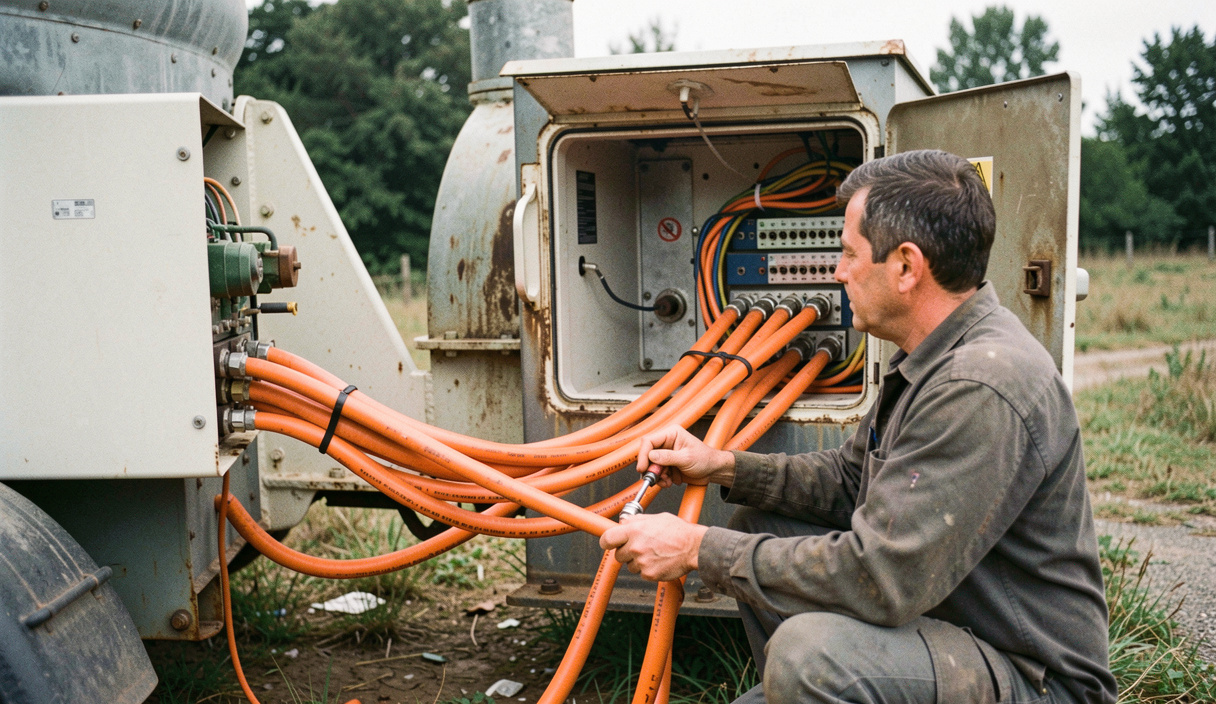
A diesel engine is designed to reach a cylinder temperature at which the injected fuel burns completely and the piston rings seal against a hot, clean liner. Below roughly thirty per cent of rated load, the combustion chamber never gets there. Fuel that does not burn does not disappear: it washes past the rings into the sump, and it leaves the cylinder as soot and as a heavy, oily condensate that collects in the exhaust manifold, the turbocharger housing and the silencer. The name comes from that wet, tarry deposit in the exhaust stack.
The consequences arrive in order. First, black smoke and a slow loss of response. Then glazed liners, because a cool cylinder wall polished by diluted oil stops holding the honing pattern that lets the rings bed. Then oil dilution, which drops viscosity exactly when the bearings need it. Then, on turbocharged machines, carbon on the turbine side and a seal that starts to pass oil. A set can pass its monthly no-load exercise for five years and still fail the first hour of a real outage.
Below about 30 per cent of the rated output, most naturally aspirated and turbocharged diesels run too cool for complete combustion. Engine manufacturers publish their own figure, and it should always be taken from the manual for the specific engine family rather than from a general rule. The generic threshold is a planning figure, not a permission.
Why a load bank and not the building
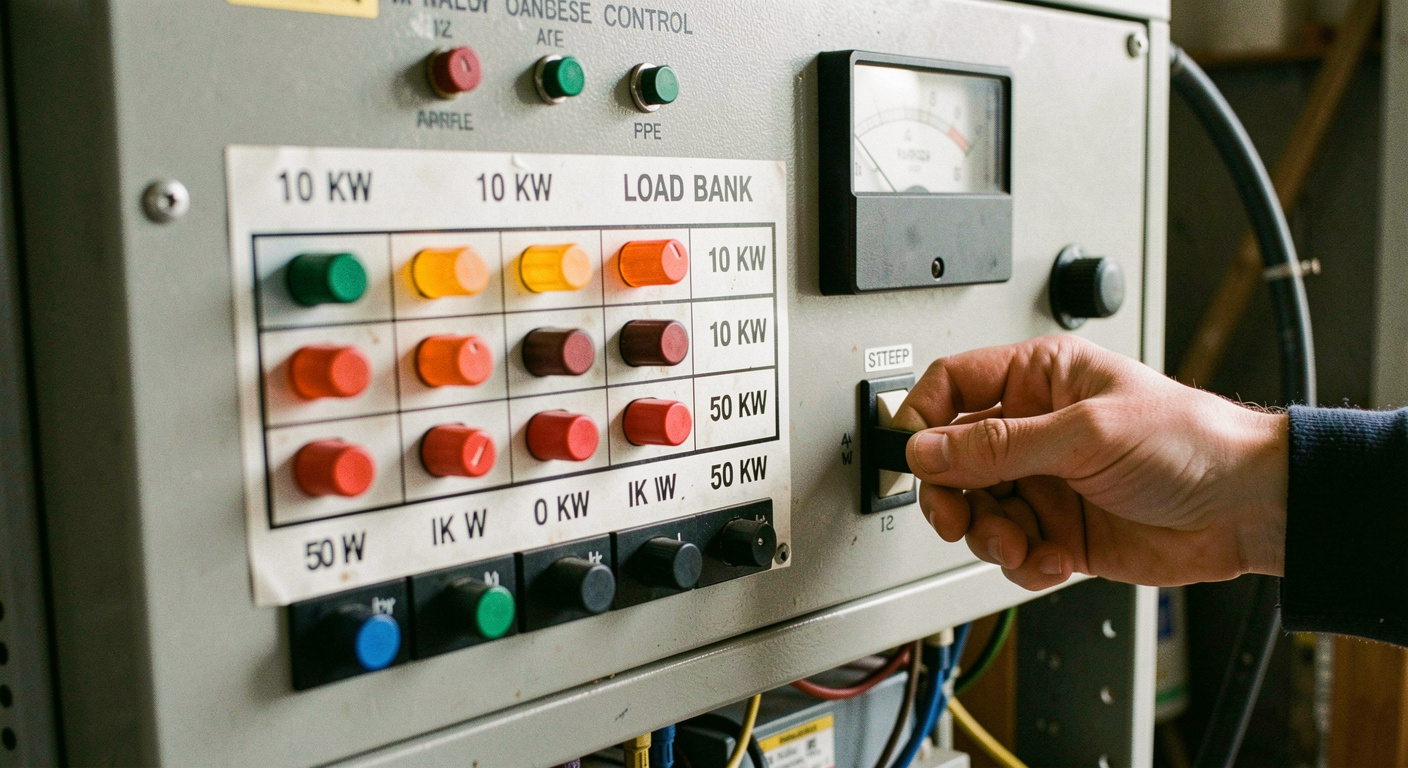
The building load is rarely available for a test, rarely large enough, and never controllable. A load bank is a bank of resistive elements, cooled by its own fans, that converts electrical output into heat and lets the operator dial the load in steps. Trailer units in the hundreds of kilowatts are common; larger installations use a permanently piped and cabled connection point so the test does not require a crane.
Three types are in circulation. Purely resistive banks load the engine at unity power factor and are the standard tool for proving the prime mover and the cooling system. Reactive banks add an inductive component so the alternator and its automatic voltage regulator are loaded at a realistic power factor, usually 0.8 lagging. Combined units do both, and are what a commissioning test on a critical installation should use, because a set that holds voltage at unity may still sag badly with reactive current flowing. The distinction matters when the acceptance criteria refer to the performance classes described in the ISO 8528 duty ratings.
Planning the test
The plan is written before anyone books a load bank. Four questions settle it.
- What is the target? A cleaning run aims to get exhaust temperature up and hold it. An acceptance test aims to prove output, voltage and frequency behaviour, and cooling, against a written criterion.
- Where does the load connect? At the alternator terminals, the set alone is tested. Downstream of the transfer switch, the distribution and the transfer sequence are tested with it, which is usually what an operator actually wants to know.
- Is there fuel? A four hour test at 75 per cent on a 500 kVA set is a serious quantity of diesel. Tank level, delivery lead time and the condition of that fuel all belong in the plan, which is why this page and the guide to fuel tank water, sludge and contamination are usually read together.
- Where does the heat go? A resistive bank rejects almost all of its load as hot air. Placed badly, it recirculates into the generator room air intake and the test ends in a high coolant temperature alarm that says nothing about the machine.
A typical staged sequence
The sequence below is a common shape for an annual proving test on a standby set. The exact steps, hold times and acceptance limits belong to the specification for the installation, and to the engine manufacturer's own instructions.
| Stage | Load | Hold | What is being watched |
|---|---|---|---|
| Warm up | No load | 5 to 10 min | Oil pressure, coolant rise, no leaks, no abnormal noise |
| Step 1 | 25 % | 15 min | Voltage and frequency recovery after the step, exhaust colour |
| Step 2 | 50 % | 30 min | Coolant temperature stabilising, oil pressure steady |
| Step 3 | 75 % | 60 min | Exhaust temperature, smoke clearing, room ventilation adequate |
| Step 4 | 100 % | 60 min or per spec | Full output held, temperatures within limits, no derating |
| Cool down | No load | 5 min | Turbocharger cooling before shutdown |
Two details separate a useful test from a box-ticking one. Load is applied in steps, not ramped, because the recovery of voltage and frequency after each step is the measurement that matters, and it is the same measurement discussed in sizing for step load acceptance. And the machine is held at each step long enough for temperatures to settle, which on a large set means half an hour, not five minutes.
What to record
A test that is not written down did not happen. The log sheet should carry, at every step: kilowatts and kilovolt-amperes, line voltages, frequency, oil pressure, coolant temperature, exhaust temperature where a probe exists, fuel level, ambient temperature in the room, and the running hours at start and finish. Ambient matters more than most operators expect, because a set proven at 12 degrees in February will not repeat the same figures at 34 degrees in August, and the difference is a derating question rather than a fault.
The completed sheet joins the machine's documentation file with the commissioning report and the rating plate data. What that file should contain, and why a factory acceptance test report is worth reading line by line, is set out in the certification and standards page.
How often, and what happens if it was never done
The common pattern on standby plant is a monthly exercise on whatever load is available, plus one annual load bank test that reaches full rated output. Critical installations, and the healthcare installations described in the installation profiles for building standby plant, are usually held to a stricter regime with a defined minimum load and a defined duration, written into the operating procedure of the site.
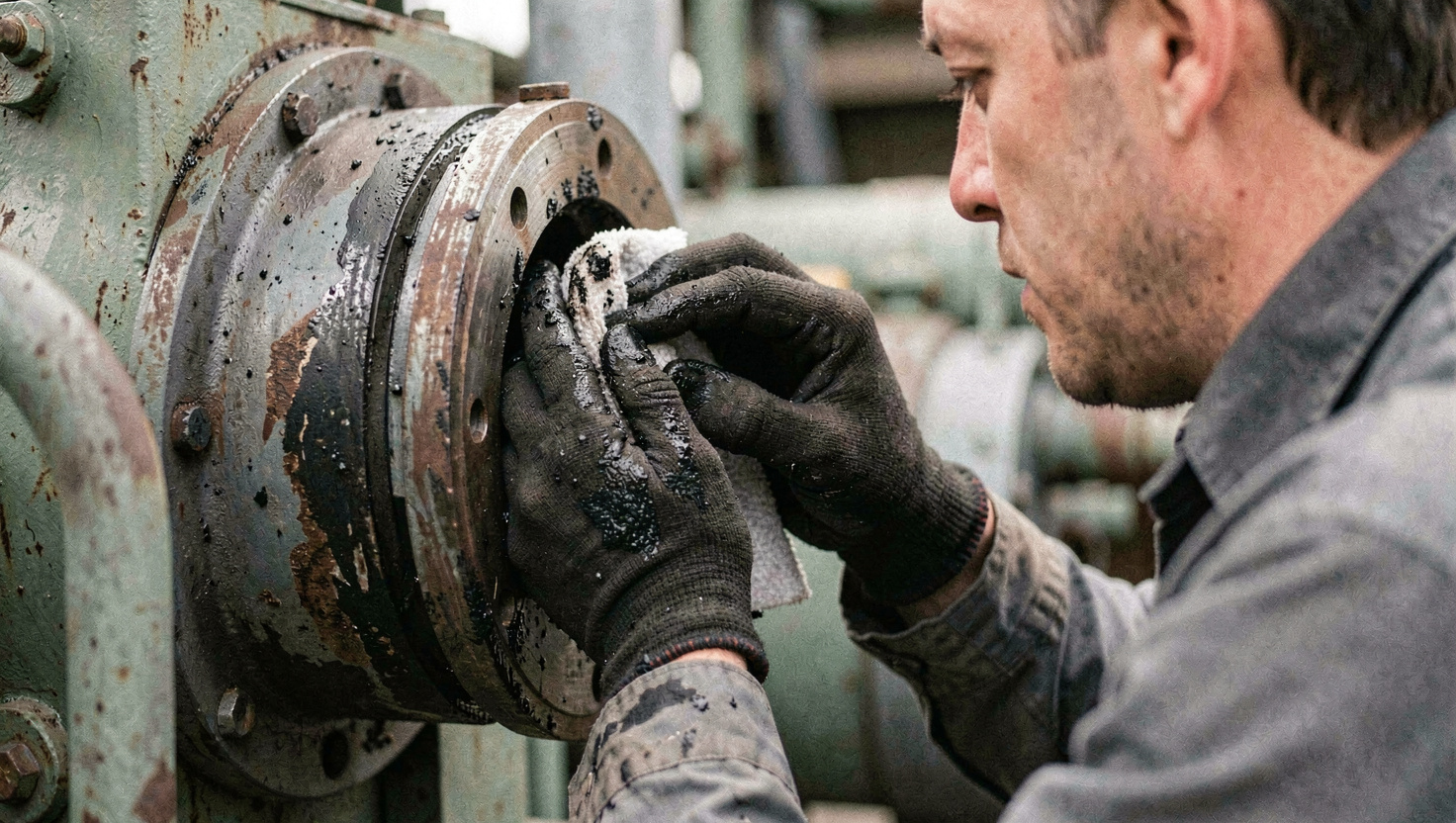
Where a set has already wet stacked, the first load bank run is not a test, it is a cleaning operation, and it should be treated as one. Expect heavy black smoke for the first period at high load, expect it to clear as the exhaust dries out, and inspect afterwards. Where the engine is electronically controlled, the fuel cleanliness question that follows is set out in the Cummins platform page. If the smoke does not clear, or if oil consumption stays high, the liners may already be glazed, and that is an engine job rather than a scheduling one. The set should also be watched for coolant temperature during the run, since a machine that has never worked hard has never proved its radiator either, which is the subject of the guide to overheating and its causes.
Check that the set can be taken off standby duty for the whole window, that the fuel in the tank is fit to burn, that the exhaust route can take a full load run, and that the load bank exhaust air has somewhere to go. Most aborted tests fail on one of those four, not on the engine.
Read next
For how a graded, dated result stays comparable over years, see the registry approach to plant records.
The rating on the plate decides how much of this test a machine is allowed to pass, which is why the duty ratings that govern how much of this test a machine may pass is the companion page to this one.
If the fuel has been in the tank since the last annual test, read fuel tank water, corrosion and contamination before you commit to four hours at full load.
For a set that lives in a hot, badly ventilated room, the derating and the cooling limits are covered in the overheating and load imbalance guide, and the whole schedule sits in the maintenance section index.
Where long idle periods are the normal state, the exposure is described in the airfield set's low-load exposure.