Genset Digest / Diesel Generator Sets / Gas-fired generator sets
Gas-fired generator sets: when natural gas or propane replaces diesel
A gas-fired generator set is a spark-ignited engine running on pipeline natural gas or stored propane, and it earns its place where a dependable gas service exists or where stored diesel is more trouble than it is worth. The price is a lower rating on natural gas, a softer response to sudden load, and, for life-safety loads in the United States, the approval of the authority having jurisdiction.
The question usually arrives from one of two directions. A facilities manager tired of sampling, testing and polishing a tank of diesel asks whether the gas main outside could feed the standby set instead. Or a homeowner comparing air-cooled standby units finds two output figures on the same datasheet and wonders which one applies to the house. Both questions have the same answer underneath: the engine is different, the fuel behaves differently in the cylinder and in storage, and the codes treat a pipe and a tank in very different ways.
What exactly is a gas-fired generator set?
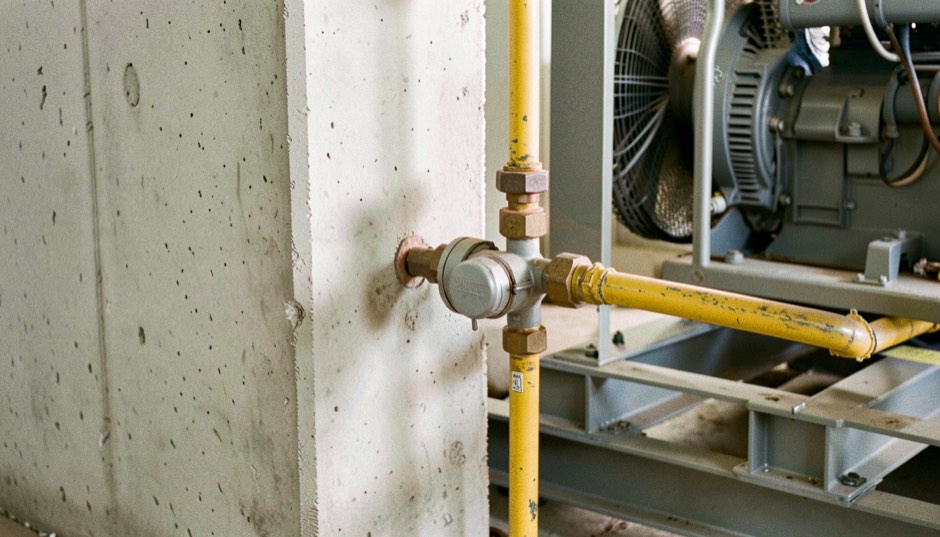
It is the same three machines found on any set, an engine, an alternator and a controller, with the compression-ignition diesel replaced by a spark-ignited engine. The fuel arrives either as natural gas from a utility pipe at low pressure, or as propane stored on site as a liquid and drawn off as vapour. Small air-cooled units built for houses sit at one end of the range. At the other, liquid-cooled sets built on industrial engine platforms reach into the megawatt class: in a 2021 answer to consulting engineers, a Cummins technical advisor put the company's gaseous sets for NFPA 110 Type 10 duty at up to 1.3 MWe, and up to 2 MWe where a slower start is acceptable.
The alternator and the controls do not care which fuel turns the shaft. Everything that changes sits upstream of the crankshaft: the fuel train with its regulator and shut-off valves, the ignition system, the way the engine answers a sudden load, and the paperwork that decides whether the fuel counts as being on the premises. That is why the duty class and correction logic described in the generator set section still apply unchanged to a gas machine.
Why does the same set carry two ratings?
A gas engine is rated per fuel. Kohler's engineering note on ISO 8528-5 says so in one line: fuel type, natural gas or propane, affects the rating. Datasheets for air-cooled home standby units therefore print two outputs, and the natural gas figure is the lower one. One widely sold 26 kW air-cooled unit is listed at 26 kW on propane and 22.5 kW on natural gas, a gap of about 13 per cent on the same engine and enclosure. A load list checked against the propane figure on a house fed from the gas main is short by that margin before any correction for heat or altitude has been made.
The energy carried by each fuel explains why storage, more than price, usually settles the choice. The conversion factors published by the US Energy Information Administration give 137,381 Btu for a gallon of diesel, 91,452 Btu for a gallon of propane and 1,036 Btu for a cubic foot of natural gas. A tank of diesel therefore holds about one and a half times the energy of the same tank filled with liquid propane, and matching the energy of one gallon of diesel takes roughly 133 cubic feet of pipeline gas.
| Fuel | Energy content (EIA) | How it reaches the set | While the set waits | US stationary engine rule |
|---|---|---|---|---|
| Diesel | 137,381 Btu per gallon | Stored on site, base tank or day tank | Takes in water, grows microbes, oxidises; tested at least yearly under NFPA 110 | 40 CFR 60 Subpart IIII |
| Propane | 91,452 Btu per gallon | Stored on site as a liquid, drawn off as vapour | Can be held indefinitely in a pressure vessel | 40 CFR 60 Subpart JJJJ |
| Natural gas | 1,036 Btu per cubic foot | Utility pipe, nothing stored | No stored fuel to age; supply depends on the utility | 40 CFR 60 Subpart JJJJ |
Can a gas set take a sudden load like a diesel?
Less readily, and the standard allows for it. ISO 8528-5 grades transient response in classes G1 to G3, with G3 the strictest and G4 left to agreement between buyer and maker. According to the Kohler note, which takes its figures from the 2022 edition of the standard, a G3 diesel may dip by 7 per cent in frequency when a load step is applied, while a gas engine is allowed 15 per cent; at G3 the frequency must recover within 3 seconds and the voltage within 4. The size of each acceptance step is set from the engine's brake mean effective pressure, and higher BMEP engines take smaller steps. The same note gives the cause plainly: gaseous engines respond more slowly because of the way their fuel is delivered.
The gap has narrowed on machines designed for standby. Gas ranges intended for emergency duty are now published as accepting their full rating in one step, and the Cummins advisor quoted above put the company's Type 10 sets at 6 to 8.5 seconds from start signal to ready-to-load, inside the 10 seconds that NFPA 110 Type 10 allows for the whole emergency supply, a sequence described step by step in what starts when the mains drop. The practical lesson is the one built into the sizing method: write down the largest motor step and the dip the loads can tolerate, then ask for the transient test result at that step.
A G3 label states the limits a set stays within; it does not state how close to them the set runs. The transient test report at your own largest load step is the only document that answers the question, for a gas set as for a diesel.
Is pipeline gas allowed to feed an emergency system?
In the United States the answer sits in the National Electrical Code. Article 700, which covers emergency systems, says that prime movers must not depend solely on a public utility gas system for their fuel, and requires automatic changeover where two fuel supplies are installed; Article 701 carries the same language for legally required standby systems. The exception lets the authority having jurisdiction accept off-site fuel where the chance of the gas supply and the electricity supply failing together is low. Where an engine runs on stored fuel, Article 700 asks for enough on the premises for at least two hours at full demand.
In practice the acceptance is a file, not a sentence. The Cummins advisor described the route as a conversation between the design engineer, the gas utility and the authority, often supported by an uptime record or a letter from the utility. Optional standby systems under Article 702, which cover a house or the loads a business chooses to protect, are not held to that fuel rule and can be connected to the utility gas line, which is why, on a home unit, the two ratings matter more than the code question.
What happens to the fuel while the set waits?
This is where gas earns its place. Stored diesel is a consumable: it takes in water, feeds microbial growth at the water interface and oxidises, the sequence set out in the fuel tank guide. NFPA 110 calls for a fuel quality test at least once a year using ASTM methods, and the Cummins advisor recommended a proper analysis of any diesel stored for 12 to 16 months. Polishing systems that recirculate the tank through filters extend that life, but they are one more machine to maintain.
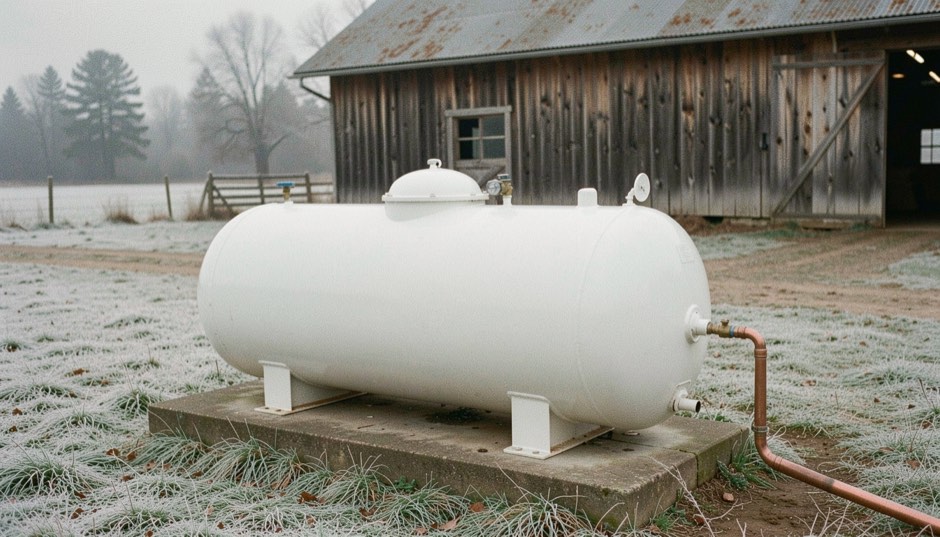
Propane held as a liquid in a pressure vessel can be stored indefinitely, and pipeline gas is not stored at all. The catch with propane is vaporisation: a tank feeding vapour must be large enough to boil off the engine's full-load demand at the coldest temperature the site will see, or the engine starves on the night it is needed. Liquefied natural gas, by contrast, slowly boils away in storage and suits prime or base-load sets better than standby ones.
Light running is the other difference. A diesel exercised at low load suffers wet stacking, which is why NFPA 110 exercises diesel sets at 30 per cent of nameplate or at a load that holds the exhaust temperature the maker recommends. Spark-ignited sets are exercised at the available emergency load, and the NFPA 110 committee's stated reason is that they are not subject to wet stacking.
Why do construction sites still run on diesel?
Industry reports on construction generator sets list diesel and gas-fired machines side by side, as if the two were interchangeable on a site. They rarely are. Power is needed from the first week, long before any gas service is connected; the machine moves as the work moves; and a tanker delivers fuel that carries about half as much energy again per gallon as propane. Site power is also a prime duty with sharp transients from cranes and welding sets, the regime where diesel response matters most, as the comparison of site power and building standby sets out.
Gas enters the construction story at the other end, in the finished building. Where the permanent building will have a gas service, the standby set specified at design stage can be gas-fired, provided the load steps, the code route and the plant room ventilation are settled together rather than one after the other.
What do the emission rules change in the United States?
Stationary engines are regulated by ignition type. Diesel units fall under 40 CFR Part 60 Subpart IIII and spark-ignited gas units under Subpart JJJJ, and both give emergency engines the same running allowance, set out for gas engines in 40 CFR 60.4243: no time limit during an emergency, a maximum of 100 hours per calendar year for maintenance checks and readiness testing, and up to 50 hours of non-emergency use counted inside those 100. The rule therefore rarely tips a pure standby decision either way. It starts to matter when an owner wants the set to run for anything other than emergencies and testing, because those hours are capped.
Three questions buyers ask
Is a natural gas generator set allowed for life-safety loads?
Under Article 700 of the US National Electrical Code, only where the authority having jurisdiction accepts that the gas supply and the electricity supply are unlikely to fail together. Otherwise the engine needs fuel stored on the premises, propane or diesel, or a second supply with automatic changeover.
How much output does a set lose on natural gas?
It depends on the model and is printed on its datasheet. One widely sold 26 kW air-cooled home standby unit is listed at 22.5 kW on natural gas, about 13 per cent below its propane rating, and the load list has to be checked against the figure for the fuel actually connected.
Does a gas-fired set need the 30 per cent load exercise?
No. NFPA 110 sets the 30 per cent figure, or a minimum exhaust temperature, for diesel sets because of wet stacking. Spark-ignited sets are exercised at the available emergency load, but they still need their monthly run to prove the battery, the start and the transfer.