Genset Digest / Maintenance & Operation Guides / Fuel tank problems
Generator Fuel Tank Problems
Fuel tanks fail slowly and then all at once. Water, corrosion and seal failure arrive in a predictable order, and there is an order in which to check them that saves a great deal of pointless work on the injection system.
Fuel tanks fail slowly and then all at once. For years the tank does nothing visible: it holds diesel, it takes a delivery occasionally, and nobody opens it. Then a set is asked for four hours at full load, and twenty minutes in, the fuel filter blocks. The tank did not fail that morning. It had been failing since the second year.
Three problems account for almost all of it, and they arrive in a predictable order: water, then corrosion and biological growth, then the seal and fitting failures that let more water in. Checking them in the right order saves a great deal of pointless work.
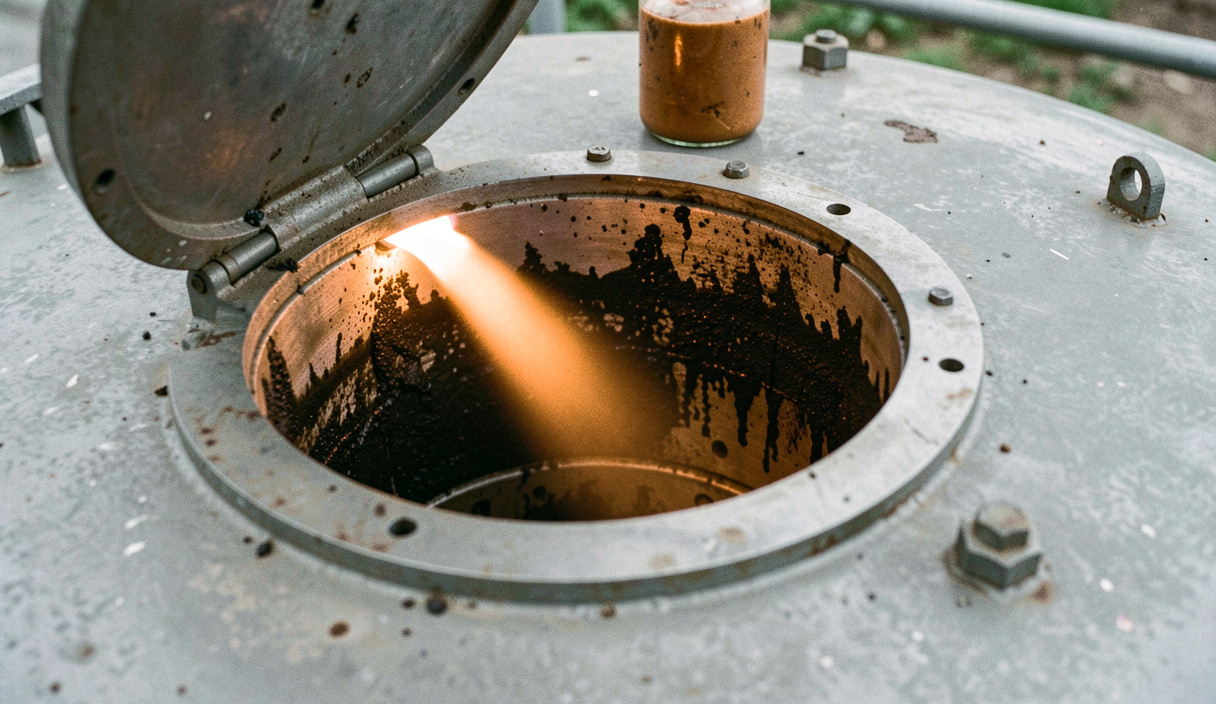
Where the water comes from
Almost every tank problem begins with water, and most of the water is made on site rather than delivered. A tank that is half empty holds a volume of air that breathes in and out with the daily temperature cycle. Warm, humid air enters through the vent in the afternoon; at night the tank cools and the moisture condenses on the internal walls and runs down to the bottom. A tank kept full has less air to breathe and makes far less water, which is the single cheapest preventive measure available.
Water at the bottom of the tank does three things. It corrodes the steel from the inside. It provides the water phase that diesel-degrading microbes need to grow at the fuel and water interface. And, because modern diesel commonly contains a biodiesel fraction that holds more water in suspension and feeds that growth more readily, it does all of this faster than it did twenty years ago.
| Step | Check | What it tells you |
|---|---|---|
| 1 | Draw a sample from the lowest drain point | Free water, sediment, colour, smell |
| 2 | Water finding paste on a dip stick | Depth of the water layer, if any |
| 3 | Water separator bowl and its drain | Whether the first defence is working |
| 4 | Filler cap seal, vent, gauge and sender seals | Where new water is getting in |
| 5 | Internal inspection through the hatch | Corrosion, sludge, biological mat |
| 6 | Fuel analysis if the sample is doubtful | Whether the fuel is fit to burn at all |
Corrosion, and what it does downstream
Internal corrosion at the water line produces rust particles that are both abrasive and filter-blocking. They sit quietly at the bottom of the tank while the set is stopped, then get stirred into suspension the moment a real load raises the fuel draw rate and the return flow starts agitating the tank. That is why a machine that has passed every monthly exercise for five years can block a filter on its first serious run, a pattern discussed in the load bank testing guide.
On electronically controlled engines the consequence is more expensive than a filter. Injection systems working at high pressure with fine clearances are far less tolerant of particulate and water than the older mechanical systems they replaced, a point set out in the Cummins platform page.
A hard start, a rough first minute or a hunting engine after a filter change usually means air is entering the suction side. Look at the fittings between the tank and the lift pump, the filter head seal and the level of fuel in the tank before anyone touches the injection pump. The pump is almost never the problem, and it is always the most expensive thing to have replaced unnecessarily.
Seals, fittings and the parts that age
The filler cap seal, the vent, the level gauge sender gasket and the return line union are the four points that let water and dirt into an otherwise sound tank. All four are rubber or fibre components that harden with time and temperature, and all four are cheap. On an outdoor tank they should be part of an annual inspection, because a perished filler seal under a horizontal tank top will admit rainwater directly.
The same inspection catches the fuel seep that becomes a fire risk when it finds a hot surface, which is why this page and the generator room fire safety guide are usually read as a pair.

Cleaning, polishing and when to give up on the fuel
Where the sample comes back with free water and sediment, there are three levels of response. Draining the water from the low point and renewing the filters handles a mild case. Fuel polishing, circulating the tank contents through filtration and water separation, handles a moderate one and can be fitted permanently on installations where the fuel sits for long periods. A tank with a biological mat on the walls and heavy sludge in the bottom needs to be emptied and physically cleaned, because polishing pulls from the fuel and leaves the growth in place.
Where fuel has aged past the point of use, the honest answer is disposal and replacement. That decision is easier to make with an analysis result in hand than with an opinion, and the documentation that should accompany a fuel delivery and a tank inspection is covered in the technical documentation library. The routine intervals that keep the tank out of this state sit in the maintenance section index.
Read next
Reading fuel and water signs day to day is covered in reading the water at an intake, and the room the tank sits in is covered in the building around the set.
The fuel side is also the fire side: the generator room fire safety guide covers the seep that finds a hot manifold.
For why a filter blocks on the first real load run rather than during the monthly exercise, read load bank testing and wet stacking.
On electronically controlled engines the tolerance for water and particulate is much lower: the Cummins platform page explains what changed, and the oil change guide covers the fuel dilution that goes with it.
Turning the fuel log into a carbon figure is the subject of turning the fuel log into a carbon figure.