Section index · technical resources · June 20, 2026
Process Air for Waste Sites and Forge Shops: Blowers, Ventilation and Standby Power
How blowers, ventilation and standby power support waste handling and forging shops, with selection, operating and maintenance guidance for plant teams.
This page sets out the standard blocks and what to check in each, as a companion to the documentation library.
Process air keeps waste handling areas ventilated and forge fires supplied with controlled combustion air, while standby generator sets keep fans and controls running during outages. Selection follows duty, duct layout and heat load, and operating routines follow written checks for filters, belts, bearings and dampers.
What does process air do in these plants?
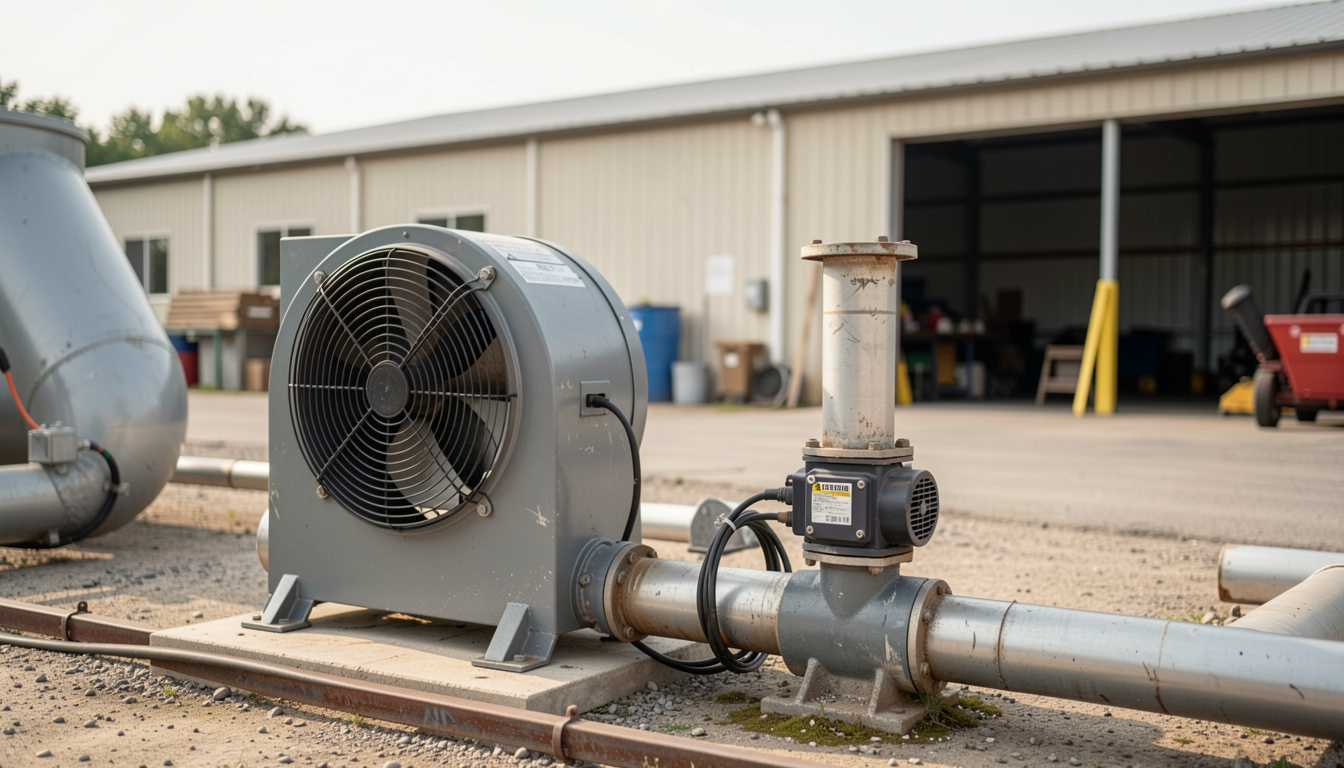
Plant teams use air as a working fluid and as a means of environmental control. In waste handling and sorting buildings, ventilation dilutes dust and odour, maintains air movement through work zones and supports dust collection hoods. In forging and heat work areas, a controlled air supply supports combustion, clears heat and fume from the breathing zone and stabilises temperatures around furnaces and work stations. In both settings, fans and blowers move air through ducts, filters and stacks, while dampers and variable speed drives adjust flow to operating conditions. Power interruptions change the situation at once, because loss of air movement can leave heat, fume and dust in place, which is why ventilation planning and standby power planning are reviewed together. Operating documents therefore describe normal flow paths, alternate operating modes and the order for restart after an outage.
Households and supers who deal with set out times and bins can consult a practical reference for residents that explains recycling, compost, bulk pickup and summonses in plain English, while plant guidance focuses on indoor air movement, collection points and housekeeping that limit dust accumulation. The distinction matters for readers of an industry publication, because municipal set out rules govern curbs and containers, whereas plant ventilation rules govern hoods, ducts, make up air and filtration inside industrial buildings.
Which blower fits which duty?
The answer follows pressure, flow stability and tolerance for dust. Centrifugal blowers suit ventilation, dust collection support and general process air where moderate pressure and steady flow are required. Positive displacement blowers suit duties that need stable flow against varying back pressure, such as air supply to furnaces or pneumatic transport sections. Axial fans suit high flow at lower pressure, such as roof exhaust or wall ventilation where duct resistance remains limited. Selection starts with a review of flow range, system resistance, inlet conditions, noise limits and maintenance access, then moves to motor sizing, drive type and control method.
For context on hot work practice and tool use, readers can review how hot iron is worked which explains what the tools are for, what the books are worth reading and the ironwork standing in Troy, Albany and Watervliet. That historical and craft perspective helps plant readers understand why air control remains central near the fire, where temperature window, hammer work and fire building depend on a steady and adjustable air supply.
| Type | Flow character | Pressure character | Typical plant use |
|---|---|---|---|
| Centrifugal backward inclined | Steady over a range | Moderate to elevated | General ventilation and process air |
| Centrifugal forward curved | High at low resistance | Limited | Supply and exhaust with clean air |
| Positive displacement lobe | Stable against back pressure | Elevated | Combustion air and transport air |
| Axial propeller | High volume | Limited | Roof and wall exhaust |
| Axial vane | High with guidance | Moderate | Ducted exhaust with straight runs |
How is ventilation planned for dust and heat?
Planning starts with source capture and general dilution. Hoods are placed near dust release points and near heat sources, ducts are routed with smooth transitions and cleanout access, and make up air is introduced to replace exhausted air without creating drafts that disturb collection. Filtration stages protect coils, fans and stacks, and differential pressure readings show when cleaning or replacement is due. In forge areas, heat plumes rise and create natural movement that exhaust openings can assist, while supply openings low in the space provide replacement air. In waste handling areas, traffic doors, tipping zones and conveyor transfers receive attention because air movement through large openings can upset pressure balance. Controls link fan speed to operating mode, time of day or sensor signals, so flow follows activity rather than running at a fixed rate through all shifts.
Named entities that shape practice include the Occupational Safety and Health Administration for worker exposure and ventilation practice, the Environmental Protection Agency for air quality and waste handling guidance, and DSNY for municipal solid waste rules in NYC. Manufacturers provide fan curves, sound data and maintenance manuals, and consulting engineers review duct sizing, stack discharge and control sequences. Historic ironwork in municipal buildings also reminds project teams that ventilation grilles, guards and supports have long been part of iron fabrication, alongside structural and decorative uses.
Why does standby power matter for air systems?
Standby power matters because ventilation, controls and auxiliary pumps often need to continue or restart in an orderly way when utility supply is lost. Diesel generator sets serve this role in many industrial sites, supplying distribution panels that feed supply fans, exhaust fans, dampers, control systems and lighting in operating areas. Load sequence matters, because motors draw starting current that can exceed running current, so staged starting avoids overload during transfer. Load bank testing is used to confirm that a set accepts load and operates at temperature, and it also addresses wet stacking that can follow extended operation at light load. Fuel storage, coolant condition, battery charge and exhaust routing receive the same attention as electrical settings, because a set that starts but cannot carry air system loads does not meet the operating intent.
Project records for such installations often describe power ranges selected for fan groups, control panels and life safety loads, along with transfer switch locations and test intervals. Case documentation from power and process air projects helps new teams see how duct modifications, damper changes or added filtration alter static pressure and therefore motor load. International experience with export markets for generator sets also informs attention to documentation, spare parts and service access, since maintenance practice must remain workable over long operating periods.
How are maintenance routines organized?
Routines are organized by interval and by system. Daily checks cover unusual noise, vibration, belt condition, guard placement and readings on pressure gauges. Monthly checks cover filter condition, damper movement, drain function and control set points. Seasonal checks cover coil cleaning, belt tension, bearing lubrication in line with manual guidance, motor cooling paths and stack caps. Maintenance and operating guides for diesel generator sets add fuel quality checks, coolant and oil checks, battery inspection, exercise runs and inspection of transfer operation. Records note date of inspection, finding, action taken and parts used, so trends in pressure drop or bearing temperature become visible over time.
- Air path: filters, hoods, ducts, dampers, stacks and weather openings
- Mechanical drive: belts, couplings, bearings, vibration mounts and guards
- Electrical and control: starters, drives, sensors, actuators and alarms
- Standby power: fuel, lubrication, cooling, batteries, transfer switch and test log
- Housekeeping: dust removal from surfaces, waste segregation and container labelling
What do operating records include?
Operating records include normal flow settings, alternate settings for reduced staffing or maintenance work, filter change history and generator test history. A technical documentation library supports this work by holding fan curves, wiring diagrams, control sequences and spare parts lists in one place where shift teams can find them. When changes occur, such as added equipment, altered duct runs or revised damper schedules, the record is updated so later troubleshooting starts from current conditions rather than from memory. Training uses the same documents, so operators, maintenance staff and supervisors share a common description of how air should move, how standby power should respond and how deviations should be reported. Over time, the record shows which measures reduced dust complaints, stabilised shop temperatures or shortened restart after outages, and that evidence guides the next round of adjustments.
Three further reads extend this page beyond process air: standby power for a rural house at the domestic scale, the rural Spain installation profile at the grid boundary, and hydrogen, fuel cells and the diesel set for the fuel question ahead.
The building-physics side of a buried intake is covered in air drawn through a buried duct.
Sources
U.S. Environmental Protection Agency, Occupational Safety and Health Administration, U.S. Energy Information Administration